In this article
Landed on someone's foot playing ball, or missed a step on a hike, and your ankle rolled and swelled up? This article explains what to do after a sprain.
First: when should I get checked?
After a sprain, the first thing to rule out is a fracture. Doctors often use the Ottawa ankle rules to decide whether an X-ray is needed. Research shows these rules accurately rule out fractures of the ankle and mid-foot and reduce unnecessary X-rays.
Get checked first if
- You can't walk four steps on your own, both right after the injury and when you're seen
- The back edge or tip of the bone on the inside or outside of the ankle is clearly tender
- The middle of the outer edge of your foot (base of the fifth metatarsal) or the inner side of the mid-foot (navicular) is clearly tender
- Your foot is numb, changes colour or feels cold
The first few days
Research supports moving early: start walking and moving your ankle as soon as you can, within what the pain allows.
Research also shows that an examination four to five days after the injury gives a more reliable picture of how badly the ligaments are injured.
After a sprain, the focus is retraining the ankle's stability and balance.
Guidelines recommend exercise as the main treatment, as it helps the ankle regain stability better than passive treatments alone.
Three ankle rehab exercises
Start within what the pain allows, and go from easy to harder. The numbers below are a starting point.

Ankle circles
Sit with your leg out in front. Slowly draw circles, or the letters of the alphabet, in the air with your toes.
10 circles each way
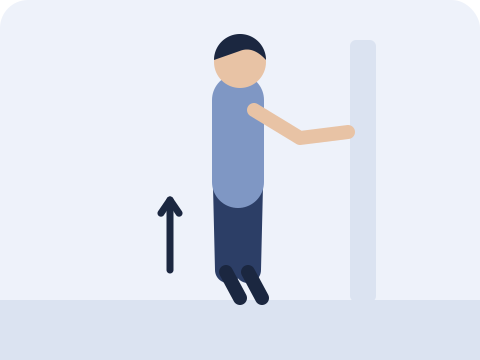
Calf raise
Hold a wall or the back of a chair, slowly rise up onto your toes, then slowly lower.
10 times | 2–3 sets
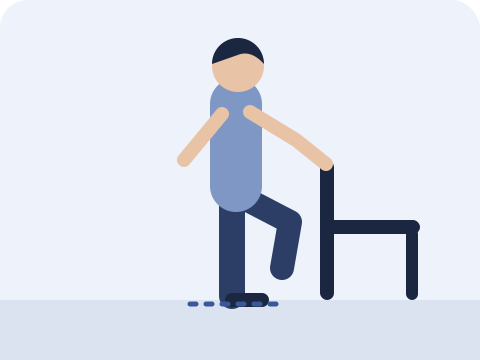
Single-leg balance
Hold a wall or the back of a chair and stand on your injured leg. Once you're steady, try letting go.
30 seconds | 3 times
While you do them
- Stay within what the pain allows, and move slowly.
- When balancing on one leg, keep something to hold on to nearby.
- Before going back to ball sports or hiking, make sure you can balance on one leg, rise onto your toes and jog without clear pain.
Common questions
Can I walk on a sprained ankle?
If you can put weight on it, research supports moving early within what the pain allows. If you can't walk four steps on your own, get checked first.
Why do I keep rolling my ankle?
After one sprain, the chance of another is higher. Research shows balance training and an ankle brace help reduce the chance of spraining it again.
Do I need an ankle brace?
Research shows a brace helps prevent repeat sprains. Whether you need one, and for how long, is worth asking a physiotherapist.
References
- Vuurberg G, et al. Diagnosis, treatment and prevention of ankle sprains: update of an evidence-based clinical guideline. Br J Sports Med 2018;52(15):956. PubMed
- Doherty C, et al. Treatment and prevention of acute and recurrent ankle sprain: an overview of systematic reviews with meta-analysis. Br J Sports Med 2017;51(2):113–125. PubMed
- Bachmann LM, et al. Accuracy of Ottawa ankle rules to exclude fractures of the ankle and mid-foot: systematic review. BMJ 2003;326(7386):417. PubMed

Anson Ko 高浩維
Registered Physiotherapist, seeing patients at Amazing Medical, Tsim Sha Tsui.About me
This article is for general reference only and does not replace professional diagnosis or treatment. If symptoms persist or warning signs appear, please see a doctor or physiotherapist.